
Published October 26, 2026
If your 1997-2004 Corvette lights up the ABS and traction control lamps and the Driver Information Center scrolls through "Service ABS," "Service Traction System" and "Service Active Handling," the most likely cause is the electronic brake control module, or EBCM. It is one of the most talked-about failures of the C5 generation. The brakes themselves still work, and the fix is often cheaper than a dealer quote suggests. This guide covers what the EBCM does, how the 1997-2000 and 2001-2004 systems differ, how to confirm the problem, and which repair makes sense for your car.
Quick Answer
- The EBCM is the computer that runs the C5's anti-lock brakes (ABS), traction control and, where fitted, Active Handling. It bolts directly to the brake pressure modulator valve (BPMV), the hydraulic block that holds the ABS pump and valves.
- When the EBCM sees a fault it can't work around, it shuts those systems off for the rest of the drive. Your normal brakes keep working, but you lose ABS, traction control and Active Handling.
- GM used two different systems: ABS 5.0 on 1997-2000 cars and ABS 5.3 on 2001-2004 cars. They are not interchangeable, so the fix depends on your model year.
- Common culprits are internal relay and solder-joint failures (code C1214), pump motor circuit faults (C1242/C1243), internal module failure (C1255), and outside causes like weak batteries, corroded grounds and wheel speed sensors.
- Your options are to repair the original module, install a used module with the matching part number, or replace the EBCM and BPMV together as a bundle.
Which Years Are Affected?
Every C5 has an EBCM, but the hardware changed during production. GM's own service guidance on C5 ABS option codes lays out the differences:
| Model year | System | What to know |
|---|---|---|
| 1997 and early 1998 | ABS 5.0 (ABS, traction control) | The ABS unit is mounted at the rear of the car on cars built before December 15, 1997. Active Handling was not available. |
| Mid-1998 to 2000 | ABS 5.0 | The unit moved to the front of the engine bay. Active Handling (RPO JL4) became an option, and cars with JL4 use a different EBCM than cars without it. |
| 2001-2004 (including Z06) | ABS 5.3 | A redesigned EBCM and BPMV. Active Handling and Dynamic Rear Proportioning became standard. 2001-2002 and 2003-2004 cars use different EBCM part numbers. |
Owners and repair shops generally agree that 2001-2004 modules are easier to repair. Early ABS 5.0 modules are harder to rebuild, and good used ones are getting scarce. That is one reason our C5 Corvette buyer's guide treats the ABS module as a key point when comparing 1997-2000 and 2001-2004 cars.
Symptoms
An EBCM problem usually looks like this:
- The ABS warning lamp and the traction control / Active Handling lamp come on together.
- The Driver Information Center shows "Service ABS," "Service Traction System" and, on cars with Active Handling, "Service Active Handling."
- The warnings appear right after start-up or at the first stop, then clear after you shut the car off and restart it. They come back more and more often over time.
- Problems that start or get worse after rain or a car wash, which points to moisture getting into the module or its connectors.
- "NO COMM" for the TCS system when you read codes on the dash, meaning the module isn't talking to the rest of the car.
- Heavier steering at parking-lot speeds. The EBCM also controls the C5's Magnasteer variable-assist power steering, so a dead or unplugged module can change how the steering feels.
The brake pedal should feel normal, and the car will still stop. What you lose is the electronic help during hard stops, on slippery roads and at the limit. Drive accordingly until it is fixed.
How the System Works
The ABS assembly sits low at the front of the engine, between the engine and the radiator (except on 1997 and early-1998 cars, where it is at the rear). It has two halves:
- The BPMV is the metal block with the brake lines, the ABS pump motor and the valves. All of the brake fluid stays in this half.
- The EBCM is the electronic box that bolts onto it. It contains the circuit board, the relays and the solenoid coils that slide over the BPMV's valve stems.
The EBCM reads the four wheel speed sensors, the brake switch and, on Active Handling cars, the steering wheel position sensor and yaw rate sensor. When a wheel locks or spins, or the car starts to slide, it fires the pump and valves to adjust brake pressure at each corner.
Each time you turn the key, the EBCM runs a self-test. That includes briefly powering the pump motor to confirm it is there. If any part of that check fails, the EBCM plays it safe. It turns ABS, traction control and Active Handling off for that key cycle and stores a trouble code.
Because the EBCM is the "dry" half, it can usually be swapped without opening the brake system. Replacing the BPMV means opening the brake lines, and the system then needs a proper bleed, which normally requires a scan tool that can cycle the ABS valves.
Common Causes and What the Codes Mean
Codes from the brake system appear under TCS when you read them on the dash. The full list, with GM's descriptions, is in our C5 Corvette diagnostic trouble codes guide. These are the ones that matter most for this problem:
| Code | GM description | What it usually means |
|---|---|---|
| C1214 | Solenoid valve relay contact or coil circuit open | The classic 2001-2004 failure. The relay inside the EBCM, or the solder joints on its pins, crack with heat and vibration. It can also be set by low voltage. |
| C1217 / C1218 | Pump motor relay contact circuit open / pump motor circuit shorted to voltage or motor ground open | A problem in the pump motor power circuit, either in the EBCM or in the BPMV pump. |
| C1242 / C1243 | BPMV pump motor ground circuit open / BPMV pump motor stalled | Common on 1997-2000 cars. These codes involve both the EBCM and the BPMV pump, which is why repairs for them often cover both halves. |
| C1255 / C1256 | ECU malfunction | An internal EBCM failure. Plan on repairing or replacing the module. |
| C1236 / C1237 | Low / high system supply voltage | Check the battery, charging system and grounds before blaming the module. |
| C1221-C1235 | Wheel speed sensor signal and circuit faults | A sensor, tone ring or harness problem, not the EBCM. |
| C1281-C1288 | Steering sensor, yaw rate and lateral accelerometer faults | Usually turns off only Active Handling. ABS and traction control may keep working. |
A few outside causes are worth knowing about:
- Weak battery or poor grounds. The EBCM is sensitive to voltage. A tired battery or a corroded chassis ground near the front of the car can set C1214 on a module that is actually fine.
- Water intrusion. A rubber seal sits between the EBCM and the BPMV. If it is damaged or left out during a repair, water can get in and ruin the circuit board.
- Stainless steel brake hoses. In a July 2004 TechLink article, GM said some 1997-2004 Corvettes showed Service ABS, Service Active Handling and Service Traction Control messages, plus wheel speed sensor codes, after the factory rubber brake hoses were replaced with aftermarket stainless steel hoses. GM's advice was to put the original rubber hoses back before diagnosing further.
- Early 2001-2002 software. GM bulletin 01-05-25-004 covered 2001-2002 Corvettes built before a set VIN breakpoint that showed "Service Active Handling" with code C1288. The fix was a dealer reprogram of the ABS module.
We found no NHTSA safety recall for the C5 ABS or EBCM. Repairs are an owner expense.
How to Diagnose It
- Read the codes on the dash. With the engine off and the ignition on, press RESET to clear any warnings. Then hold OPTIONS and press FUEL four times within five seconds. Write down every code listed under TCS, and note whether each one is current (C) or history (H). Our C5 on-board diagnostics guide walks through every step.
- Clear the codes and drive. Restart the car and see which codes come back. A code that returns right away is the one to chase.
- Check the battery and charging voltage. Load-test the battery and confirm the alternator is charging. Fix any voltage problem first, then clear the codes again.
- Clean the connections. Inspect the EBCM harness connector for bent or green pins. Then clean the chassis grounds near the front of the car with a wire brush.
- Rule out sensors. Wheel speed sensor codes point to the sensor or its harness. Steering sensor and yaw codes point to those parts. Neither group is an EBCM failure.
- Identify your module. If the codes point inside the EBCM (C1214, C1255/C1256, or C1242/C1243 on early cars), read the part number on the module's label. Replacement modules must match it.
- Know when the BPMV is involved. GM's procedure for pump and relay codes includes checking the pump motor circuits for a short to the BPMV housing. If the pump is shorted, replacing only the EBCM won't fix it, and the new module can be damaged.
Fix Options Compared
1. Repair or Rebuild Your Original Module
For 2001-2004 cars, rebuilding the original EBCM is usually the best value. You remove the module, ship it in, and get it back repaired. Because it is your own unit, the part number is already correct for your car. Our C5 ABS Module Rebuilding Service (2001-2004) covers the internal relay and solenoid valve codes, including C1214, as well as no-communication faults.
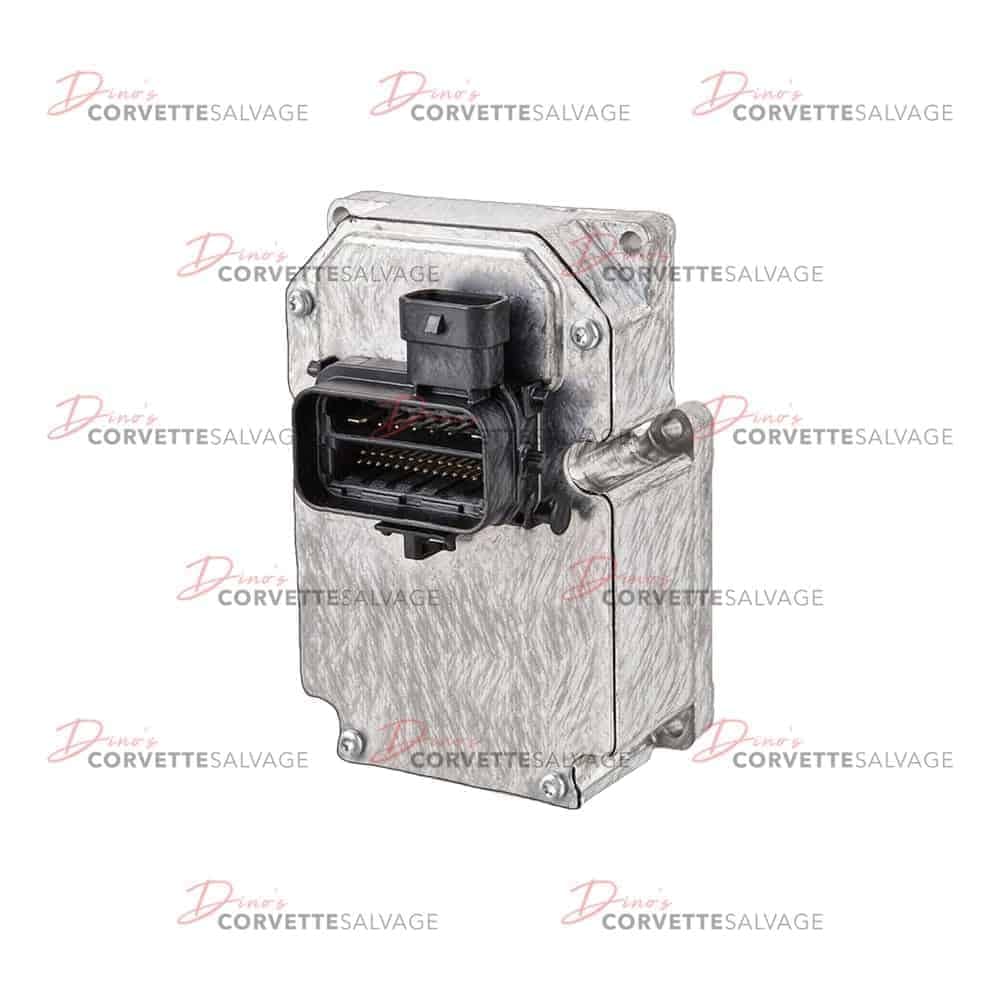
It also offers an optional surge suppression upgrade. The upgrade is meant to soften the voltage spike the pump motor creates during the start-up self-test, which is hard on the module's electronics.
For 1997-2000 cars with C1242 or C1243, our C5 EBCM/BPMV Repair Service (1997-2000) repairs the EBCM and the BPMV pump together. You send both halves as one assembly. This service covers C1242 and C1243 only.
Price at time of writing: 2001-2004 rebuild $365, or $460 with surge suppression. 1997-2000 C1242/C1243 repair $1,095.
2. Do-It-Yourself Relay and Solder Repair
Plenty of 2001-2004 owners have fixed C1214 themselves. They open the EBCM, reflow the cracked solder joints on the relay pins, or replace the relay. A widely read CorvetteForum write-up and a popular YouTube video show the process.
It costs very little, but it means cutting the factory sealant, soldering on a delicate circuit board and resealing the case well enough to keep water out. If that sounds risky, use the rebuild service.
3. Install a Used EBCM
A good used EBCM is the quickest fix if you want the car back on the road the same day. The key is matching the part number on your original module. Watch these splits:
- 1997-2000 modules don't fit 2001-2004 cars, and the reverse is also true.
- On 1998-2000 cars, Active Handling cars and non-Active Handling cars use different modules.
- 2001-2002 and 2003-2004 cars use different modules.
We list a C5 Used Electronic Brake Control Module (EBCM) 1997-2004 with each of these versions as a separate option.

Price at time of writing: $895 for 2001-2002 or 2003-2004, $1,000 for 1997-2000 without Active Handling, and $1,300 for 1998-2000 with Active Handling. All versions were out of stock when we checked, so ask about availability.
4. Replace the EBCM and BPMV as a Bundle
If the pump in the BPMV has failed, or you can't confirm which half is bad, replacing both halves together removes the guesswork. Our C5 Used Electronic Brake Control Module & Valve Bundle 1997-2004 pairs a matched EBCM and BPMV. A used C5 Brake Pressure Modulator Valve is also available on its own.
Plan on a full brake bleed with a scan tool after replacing the BPMV.
Price at time of writing: bundle $1,895 for 2001-2004, $1,995 for 1997-2000 without Active Handling, and $2,395 for 1998-2000 with Active Handling. BPMV alone $495 (2001-2004).
5. Convert a 1999-2000 Car to the Later System
Some 1999-2000 owners have converted their cars to the 2001-2004 EBCM and BPMV. The job also needs the later bracket, harness connector, brake lines, pressure sensor and steering wheel position sensor, plus careful rewiring. A detailed DIY account on CorvSport shows it can be done, but it is a project, not a weekend swap. It mainly makes sense if you can't find a working early module.
Which Fix Should You Choose?
- 2001-2004 with C1214 or no communication: Rebuild your original module. It is the lowest-cost reliable fix and avoids part-number mix-ups.
- 1997-2000 with C1242 or C1243: Use the EBCM/BPMV repair service, or install a used module or bundle that matches your part number and Active Handling option.
- C1255 or a water-damaged module: Plan on a used EBCM or a bundle.
- Pump motor shorted to the housing: Replace the BPMV, or buy the bundle, and have the system bled.
- Sensor or voltage codes only: Fix the sensor, wiring or battery first. The module may be fine.
Frequently Asked Questions
Is it safe to drive with the Service ABS message on? Your base brakes still work, so the car will stop normally. ABS, traction control and Active Handling are off, so wheels can lock under hard braking and the rear can step out more easily on wet roads. Drive gently and get it diagnosed soon.
What does the EBCM do on a C5 Corvette? It runs the anti-lock brakes and traction control, Active Handling on cars that have it, and Dynamic Rear Proportioning on 2001-2004 cars. It also controls the Magnasteer variable power steering assist.
Can I swap a 2001-2004 EBCM onto my 1999? Not by itself. The 2001-2004 module uses a different BPMV, a different connector and different sensors. A full conversion is possible, but it takes a lot of parts and wiring.
Do I need to bleed the brakes after replacing the EBCM? Not if you replace only the EBCM, because it is the dry half of the assembly. Replacing the BPMV opens the brake system and calls for a proper bleed.
Does a used EBCM need programming? A used module with the same GM part number is generally plug-and-play. If your car still shows warnings after the swap, clear the codes and check for a part number mismatch first.
Why do the lights go away when I restart the car? The EBCM shuts the systems off for the rest of the key cycle when it sees a fault, then retests at the next start. An intermittent relay, solder joint or connection can pass that test one time and fail it the next.
Sources
- GM service information, "Clarification of ABS-Related Option Codes," 1997-2004 Corvette (ABS 5.0 vs 5.3, JL4/JL9, mounting location).
- GM TechLink, "Stainless Steel Brake Lines," July 2004.
- GM service bulletin 01-05-25-004, 2001-2002 Corvette "Service Active Handling" with DTC C1288.
- NHTSA recall search for 1997-2004 Chevrolet Corvette found no ABS or EBCM recall.
- CorvetteForum, "C1214 Sol Valve relay Contact or coil CKT Open" (troubleshooting and EBCM removal).
- CorvetteForum, "How-To repair EBCM avoiding costly repairs" (2001-2004 relay and solder repair).
- CorvetteForum, "The exact date of EBCM design change."
- CorvSport, "DIY Guide: How To Update The Problematic EBCM On Your Early C5 To A 2001+ EBCM."
- Corky Cars (YouTube), "C5 Corvette EBCM traction control fix under $15.00 2001-2004."